DNA Starter Kit Handbook
A guide to sharing, collaborating, and building open biotech together with Reclone.

DNA Starter Kit Handbook
A guide to sharing, collaborating, and building open biotech together
Whether you've just received your first batch of open-source DNA tools from Reclone or an affiliated researcher - or you've been with us for a while - welcome! You're now part of a global network working to build open, local, and sustainable biotechnology together.
🌎 The Reclone Starter Kit
The Reclone Starter Kit is a project supported by the Chan Zuckerberg Initiative (CZI) to expand access to open biotechnology tools and strengthen local research capacity across the region.
The Starter Kit contains 10 lyophilized plasmids encoding various enzymes and proteins for use in molecular biology and teaching. These include DNAs for PCR enzymes (Pfu_Sso7d, Taq, and OpenVent); o-MMLV reverse transcriptase; and Bst-LF polymerase (LAMP). It also includes DNA for fluorescent proteins that can be used to teach protein purification.
The DNA is shipped in 0.2 mL tubes, which are placed inside a 50 mL tube to prevent issues during shipping. Each tube is labeled with the name of the plasmid. The 0.2 mL tubes are also covered with sealing film to prevent the entrance of unwanted particles and to keep dried DNA pellets inside. All of them should have between 150 and 200 ng of dried plasmid DNA.
Most constructs in this kit are built in the pTI backbone — developed by the Federici Lab (Pontificia Universidad Católica de Chile) as a Golden Gate BsaI acceptor and expression vector. Functionally, pTI is designed to behave like the widely used pET28a system: it shares the same pBR322-derived origin of replication (with the ROP gene to keep copy number low) and the same constitutive lacI repressor cassette, so plasmid copy number, LacI levels, and T7 RNA polymerase regulation in BL21(DE3) closely mirror pET28a.
Eight of the ten expression constructs in this kit pair a T7lacO promoter with an N- or C-terminal 6×His (or 10×His) tag for IMAC purification. The remaining two — the constitutively expressed J23101_mScarlet and J23101_sfGFP reporters — use the constitutive J23101 promoter instead of T7 and carry no His tag; they're intended for visual screening (e.g., confirming successful transformation) rather than affinity purification. See the pTI Plasmid Datasheet for the full backbone reference.
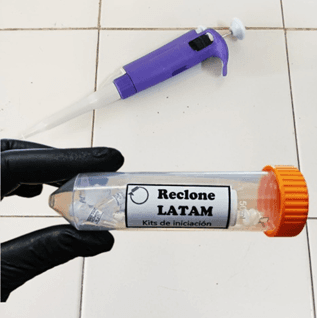
The kit includes:
-
OpenVent_mCherry in pTI
-
Taq* (BearMix) in pET28a
-
oMMLV (Superscript) in pTI
-
HIV-RT in pTI
-
Pfu Sso7d in pET28
-
fuGFP_HisTag in pTI
-
Scarlet (constitutive) in pTI
-
Bst-LF in pTI with HisTag
-
mScarlet-I_HisTag (T7) in pTI
-
SfGFP (constitutive) in pTI
| Tube name | Full name | Resistance | Description |
|---|---|---|---|
| OpenVent_mCherry (pTI) | pTI_T7lacO_6xHis_mCherry_T7Term | Kanamycin | Assembled by the Open Bioeconomy Lab |
| Taq (BearMix) (pET28) | pET28_T7LacO_6xHis_thromb_Taq_T7Term | Kanamycin | Originally from Robert Tjian's Lab |
| oMMLV (pTI) | pTI_T7lacO_RiboJB34_His_GSLinker_MMLV_3xSTOP_TZ | Kanamycin | Originally from Laboratorio de Tecnologías Libres |
| HIV-RT (pTI) | pTI_T7LacO_RiboJB34_His_GSLinker_HIV_3xSTOP_TZ | Kanamycin | Originally from Laboratorio de Tecnologías Libres |
| Pfu-sso7d (pET28) | pET28_T7LacO_RBS_10xHis_fXAsite_Pfu_sso7d_T7term | Kanamycin | Originally from Alexander Klenov's Lab |
| fuGFP_HisTag (pTI) | pTI_T7LacO_B0034_6xHis_fuGFP_3xSTOP_TZ | Kanamycin | Originally from Laboratorio de Tecnologías Libres |
| J23101_mScarlet (pTI) | pTI_J23101_B0034_mScarlet-I_3xSTOP_B0015 | Kanamycin | Originally from Laboratorio de Tecnologías Libres |
| Bst-LF (pTI) | pTI_T7LacO_RiboJB34_6xHis_GSLinker_BstLF_3xSTOP_TZ | Kanamycin | Originally from Lab. de Tec. Libres and PB3 Lab |
| mScarlet_HisTag (pTI) | pTI_T7LacO_BCD2_6xHis_mScarlet-I_3xSTOP_TZ | Kanamycin | Originally from Laboratorio de Tecnologías Libres |
| J23101_sfGFP (pTI) | pTI_J23101_B0034_sfGFP_B0015 | Kanamycin | Originally from Laboratorio de Tecnologías Libres |
The main place to find more information about these parts is our GitHub repository. There is a folder for the "Starter kit" where you can find DNA sequence and annotation data, and most importantly a "Description" file with information about the collection and links to the other important files.
On GitHub, you can also let us know of any problems you experience through the Issues board. We also recommend using the Reclone Forum for troubleshooting: forum.reclone.org.
Some countries require an import permit or biosafety notification for biological materials, even non-infectious dried DNA. Check with your institution's biosafety office or customs/import regulations before requesting a shipment, so your kit isn't delayed at the border.
🔬 You Got Reagents — Now What?
The strains referenced in this guide (E. coli DH5α, TOP10, BL21(DE3)) are standard, non-pathogenic laboratory strains handled under Biosafety Level 1 (BSL-1) practice in most jurisdictions. Confirm your local/institutional biosafety classification and any Institutional Biosafety Committee (IBC) approval requirements before you begin work — rules vary by country and institution.
Storing your Kit
The dried DNA in the tubes is generally stable for extended periods at room temperature, provided it is kept in a cool, dry place. We have successfully recovered DNA after one month under these conditions; however, for long-term storage, we recommend keeping the samples at −20°C.
Retrieving the DNA
We strongly recommend transforming each plasmid into a bacterial strain suitable for plasmid maintenance, and keeping the glycerol stock at −80°C.
We recommend:
-
Quickly spin each tube before use to make sure the DNA pellet is at the bottom.
-
Remove the sealing film carefully to avoid losing the lid.
-
Resuspend the DNA in 10 µL of nuclease-free water.
-
Transform each DNA in suitable chemocompetent cells such as E. coli DH5α and TOP10 for cloning, ideally following our recommended protocol.
As the plasmids in the starter kit are ready to express, you can also transform them into expression strains, like E. coli BL21(DE3) for all the T7-driven expression cassettes.
Once resuspended, aliquot the DNA if you plan to use it over multiple sessions — repeated freeze/thaw cycles gradually degrade plasmid DNA. Label aliquots with plasmid name and date, and keep a single "working" aliquot at 4°C for short-term use while the rest stays at −20°C.
📑 Protocols to Get Started
Once you receive lyophilized plasmids, you must retrieve and introduce them into bacteria to:
-
cryopreserve them,
-
produce more plasmid, and
-
express proteins.
Transformation
We suggest the following transformation steps:
-
Allow chemocompetent cells to thaw on ice.
-
Add 5 µL of each DNA to their corresponding chemocompetent cell.
-
Incubate on ice for 10–20 min.
-
Perform heat-shock at 42°C for 55 s – 1 min.
-
Incubate on ice for 3 min.
-
Add 200 µL of LB medium to 50 µL of transformed cells.
-
Recover the cells at 37°C and 220 rpm for 1 hour.
-
Add 80 µL of each culture to LB-agar plates, previously supplemented with kanamycin (50 µg/mL in the plate).
-
Incubate at 37°C overnight. Visualize the results.
Recommended Protocol: Preparing CCMB80 Chemically Competent Cells (TOP10/DH5α)
Quality of chemocompetent cells is critical to successfully recover all the DNAs. Issues have been observed in the past with CaCl₂-based protocols, which is why we strongly suggest the CCMB80 protocol for the preparation of chemocompetent cells.
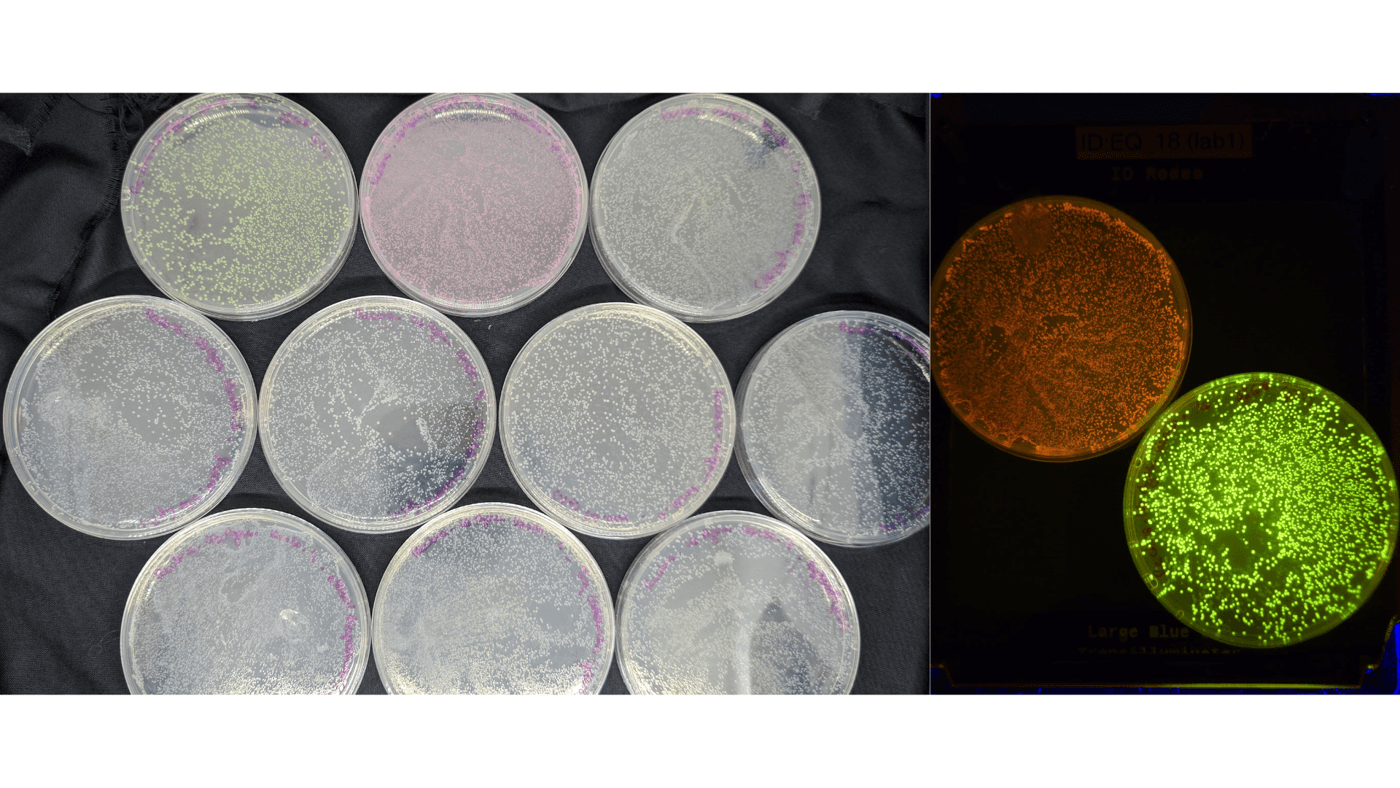
Successful transformation of the 10 plasmids from the kit in CCMB80-based TOP10 E. coli cells (left). Constructs under the J23101 promoter should express fluorescent proteins constitutively in TOP10 (right).
Other related protocols:
-
Optimized heat shock transformation protocol for Escherichia coli TOP10, JM109, and BL21 strains
-
In the absence of a spectrophotometer, use the McFarland scale
Prepare kanamycin sulfate as a 1000× (50 mg/mL) stock in water, filter-sterilize (0.22 µm), and store single-use aliquots at −20°C protected from light. Add kanamycin only after autoclaved LB-agar has cooled below ~60°C — adding it to hot media degrades the antibiotic and can produce weak or absent selection.
Storage and Re-activation
Recommended protocol: Glycerol Stock
To activate it, the cryopreserved bacterium must first be cultured on agar. Subsequently, a colony can be cultured in liquid medium to multiply. From a miniculture (1–5 mL), a large quantity of plasmid in aqueous suspension can be extracted using an extraction kit.
In the absence of an Extraction Kit, follow this recommended protocol: Alkaline Lysis Plasmid Purification
Verify plasmid integrity on an agarose gel and quantify via gel.
Prepare glycerol stocks in duplicate and store them in two physically separate freezers or locations when possible. Always draw from a stock with a sterile tip and return it to −80°C promptly — every freeze/thaw at the surface reduces viable cell recovery over time.
Protein Expression
Recommended protocols:
General liquid-culture IPTG induction (quick reference)
For plasmids carrying a T7lacO promoter (pTI and pET28-based constructs in this kit), the following generic protocol is a reasonable starting point but optimize induction temperature, IPTG concentration, and time for each individual protein.
-
Transform the plasmid into an expression strain (e.g., BL21(DE3)) and pick a single colony into 5 mL LB + kanamycin (50 µg/mL); grow overnight at 37°C, 220 rpm.
-
Dilute the overnight culture 1:100 into fresh LB + kanamycin and grow at 37°C, 220 rpm until OD₆₀₀ reaches ~0.4–0.6.
-
Induce with 0.1–1.0 mM IPTG (start at 0.5 mM if unsure).
-
Continue growth post-induction — commonly 3–4 hours at 37°C, or overnight at 16–20°C for improved solubility of difficult constructs.
-
Harvest cells by centrifugation (4,000×g, 10–15 min, 4°C); proceed to lysis and purification, or freeze the pellet at −20°C for later processing.
If yield is low, try lowering the induction temperature (e.g., 18°C overnight) and/or reducing IPTG concentration — this often improves soluble yield at the cost of total protein made. If there's no expression at all, first re-confirm the strain carries the DE3 lysogen (T7 RNA polymerase) and that the plasmid map matches what you expect by a quick colony PCR or restriction digest.
🦺 Safety & Best Practices
We recognise that many labs in our network have not worked extensively with recombinant DNA. Here are some general biosafety and lab-hygiene practices relevant to working with the strains and reagents in the Reclone Starter Kit.
Regulations for working with recombinant DNA / genetically modified microorganisms (GMMs)
-
Recombinant plasmids and the bacterial strains transformed with them are likely to be classified as genetically modified microorganisms (GMMs) under local regulation, even when the source strains are non-pathogenic.
-
Confirm your institution's requirements for GMO work, containment level, and any registration needed with your biosafety office before starting.
-
Keep recombinant strains and stocks physically separate from non-recombinant lab strains to avoid mix-ups.
-
Follow your institution's rules for transport of live cultures or plasmid stocks between labs or sites.
Biosafety regulation varies significantly by country and institution. This guide describes practices common to BSL-1 microbiology, but your Institutional Biosafety Committee (or equivalent) has the final say — check with them before your first experiment.
General handling
-
Work at a clean bench using aseptic technique: sterilize the work surface, use sterile tips and tubes, and flame the neck of tubes/flasks near a Bunsen burner or in a laminar flow hood where available.
-
Wear appropriate PPE including lab coat, gloves, and eye protection when handling live cultures, even though the strains here are non-pathogenic.
-
Label all tubes, plates, and stocks clearly with plasmid name, strain, and date; unlabeled cultures are a common source of cross-contamination and wasted effort.
-
Never eat, drink, or apply any products to your face or skin at the bench.
Waste and decontamination
-
Decontaminate all liquid and solid culture waste before disposal — autoclave (121°C, 15–20 min) or treat with a fresh 10% bleach solution (at least 30 min contact time) as appropriate for your institution's protocol.
-
Dispose of contaminated plasticware (tips, tubes, plates) in a designated biohazard waste stream, not general trash.
-
Clean the bench with a suitable disinfectant (e.g., 70% ethanol) before and after each session.
🦺 Open Material Transfer Agreement and Onward Sharing
If you received reagents from a Reclone Regional Hub or Node, or from a researcher in our extended network, we ask that you:
Respect the OpenMTA
Reclone reagents are shared under the Open Material Transfer Agreement (OpenMTA), which allows you to:
-
Use them freely for research, teaching, and local production
-
Share them onward — without restrictive terms
-
Adapt and improve them to suit your local needs
When you receive Reclone materials under the OpenMTA, you agree to:
-
Provide appropriate acknowledgment of the source of the material in all publications or presentations
-
Notify the provider if you redistribute the material to third parties
If your institution hasn't adopted the OpenMTA yet, we encourage you to start a conversation with your technology transfer office, legal department, or leadership. Formal adoption is important to fully benefit from open sharing. We're here to support you with resources and guidance every step of the way!
Planning to share these reagents with someone else?
That's great! We love to see the community grow.
If you're redistributing reagents you received, please make sure the person receiving them also fills out this quick form: Reclone Reagent Receipt Form.
This helps us keep track of how materials are circulating, offer support to new users, and connect them with the wider Reclone network.
🚀 How to Stay Involved?
Join the Reclone Forum to connect, ask questions, troubleshoot together.
Check our GitHub Repository for open tasks and issues, give us comments and feedback on protocols and documentation via Protocols.io.
